Disclosure: This tutorial is provided free of charge. PickSmart.ai may earn small commissions from purchases made through retailer links (Amazon, Best Buy) at no extra cost to you. This helps us keep the tool free and continuously improve it.
Looking for a laptop but overwhelmed by thousands of options? PickSmart.ai helps you find your perfect laptop in 2-3 minutes using a revolutionary priority-based discovery system. This complete tutorial will show you exactly how to use it.
What You’ll Learn
How the priority-based system works (and why it’s better than filters)
Step-by-step walkthrough with real screenshots
Mobile-specific instructions for touchscreen devices
Advanced tips to refine your search
Common scenarios and how to use the tool for each
How PickSmart.ai Works: The Priority System
Unlike traditional laptop finders that use rigid filters, PickSmart.ai uses a priority-based ranking system. Instead of eliminating laptops that don’t match exact criteria, it shows you the best matches based on what matters most to you.
Why this is better:
No perfect laptop exists – You’ll always compromise somewhere. The tool helps you compromise on the right things.
Discover unexpected gems – A laptop might excel in your top priorities even if it’s not perfect elsewhere.
Flexible searching – Easily adjust priorities to see different recommendations.
Data-driven – Based on analysis of 7,000+ real laptop models.
Step-by-Step Tutorial
Step 1: Access the Tool
Visit picksmart.ai in your web browser. You’ll see the region selection page where you can choose between United States and India markets.
Figure 1: Choose your region (USA or India)
Select your region to see laptops with relevant pricing and availability for your market.
Step 2: View the Tool Interface
After selecting your region (e.g., United States), you’ll see the main laptop selector interface with priority selection options.
Figure 2: Main tool interface for USA market
Step 3: Select Your Top Priorities (2-5 Parameters)
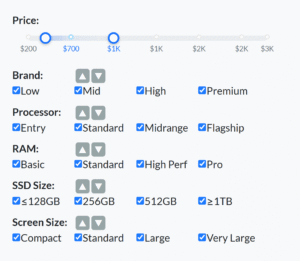
You’ll see a list of available parameters. Select 2-5 that matter most to you:
Price Filter (Choose a range – min and maximum price for your selection)
Brand (Select between Premium/ High/ Mid/ Low)
Processor (Processing speed (High end to Low end)
RAM (from 4 GB to 32+ GB)
SSD (from 64 GB to 4 TB)
Screen Size (Small-sized to Large-sized)
Figure 3: Select 2-5 priorities that matter most to you
Tip: Don’t select too many parameters. Focus on your top 3-4 priorities for best results. The more parameters you add, the fewer laptops will rank highly in all of them.
Step 4: Rank Your Priorities (Drag to Reorder)
The order matters! Your #1 priority has the most weight in the recommendation algorithm.
Desktop Users: Simply drag and drop the parameters to reorder them.
Mobile/Touchscreen Users:
Touch and hold a parameter for ~1 second until it “lifts” from the list
While still holding, drag it up or down to your desired position
Release to drop it in place
Repeat until your priorities are in the right order
Figure 4: Selected priorities – drag to rank by importance
Example Priority Rankings:
Student Budget Priority
Value Rating
Battery Life
Portability
Performance Index
Gamer Priority
Graphics Power
Performance Index
Display Quality
Value Rating
Business Professional
Build Quality
Portability
Battery Life
Performance Index
Step 5: “Visualize” your Matches
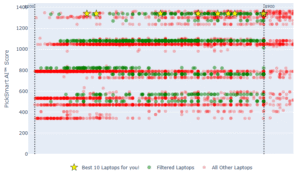
Once you’ve ranked your priorities, the tool will analyze thousands of laptops and show you a scatter plot visualization.
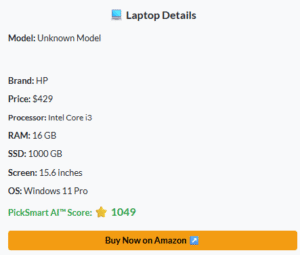
Step 6: Explore Laptop Details
Click on any point in the visualization to see the individual laptops. You’ll see:
Direct links to Amazon, Best Buy, or other retailers
Performance scores for your selected priorities
Figure 6: Detailed visualization showing your best laptop matches
Understanding the Visualization:
Each point = a cluster of similar laptops
Point position = how well laptops match your priorities
Better matches appear in optimal positions
Click any point to see the laptops in that cluster
Advanced Tips & Pro Techniques
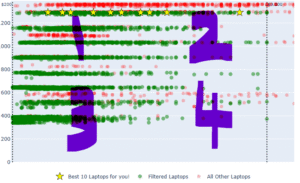
Choose the Top Left Quadrant
Section 1 refers to cheaper laptops with high performance score – Best Buys!!
Section 2 refers to costlier laptops with high performance score
Section 3 refers to cheaper laptops with low performance score
Section 4 refers to costlier laptops with low performance score
Refining Your Search
Try different priority orders: Swapping your #1 and #2 priorities can reveal completely different recommendations. Experiment!
Use 3 parameters for breadth, 5 for precision:
3 parameters = wider range of matches, more flexibility
5 parameters = narrower results, very specific needs
Understanding Trade-offs
No laptop excels at everything. Common trade-offs:
Performance vs Battery Life – Powerful processors drain batteries faster
Portability vs Display Size – Larger screens mean heavier laptops
Graphics Power vs Price – Dedicated GPUs add significant cost
Build Quality vs Value – Premium materials increase price
Frequently Asked Questions
How accurate is the data?
PickSmart.ai analyzes 7,000+ laptop models from major retailers including Amazon, Best Buy, Walmart, and manufacturer direct sales. Prices and availability are updated regularly.
Can I save my search or create an account?
Currently, the tool doesn’t require an account and doesn’t save searches to protect your privacy. Simply bookmark results or take screenshots of laptops you’re considering.
Does PickSmart.ai work outside the USA?
Yes, the tool includes data for multiple regions including USA, India, and others. Select your region at the start to see relevant pricing and availability.
How often should I check back for updates?
If you’re actively shopping, check weekly. Laptop prices fluctuate frequently, especially during sales events (Black Friday, back-to-school, etc.).
Ready to Find Your Perfect Laptop?
You now know how to use PickSmart.ai like a pro. The tool does the heavy lifting – analyzing thousands of laptops in seconds – so you can focus on making the right decision for YOUR needs.
The Laptop Shopping Problem Traditional Sites Can’t Solve
Here’s the truth: Finding the perfect laptop in 2025 takes 30-60 minutes on typical e-commerce sites, involves clicking through 20+ pages of results, and leaves you with decision fatigue wondering if you missed something better.
PickSmart.ai solves this in 60 seconds using a proprietary multi-dimensional visualization engine that shows you the entire laptop market landscape at once—not one page at a time.
After personally testing this system with 1,015 laptops across every price range (₹15,990 to ₹479,990), I can confidently say this is the fastest, most transparent way to find your perfect laptop in 2025.
The core difference? Traditional shopping sites treat all laptop specs equally. PickSmart.ai asks you to rank your priorities (performance? battery? price? portability?) and instantly clusters laptops optimized for YOUR exact needs.
Let me show you exactly how this works—and why it beats every traditional laptop shopping method.
Quick Comparison: PickSmart.ai vs Traditional E-Commerce vs YouTube Reviews
Bottom line: Traditional sites force you to think like a database. PickSmart.ai lets you think like a human—”I want gaming performance first, then battery life, then price under ₹80k.”
The Multi-Dimensional Algorithm: A New Approach to Laptop Shopping
Here’s why traditional approaches fail: Linear filtering.
Traditional E-Commerce Method (Linear):
Filter by price: ₹50k-₹70k → 300 results
Filter by RAM: 16GB → 120 results
Filter by processor: Intel i7 → 40 results
Problem: You’re still clicking through 4 pages, unsure if you optimized correctly
PickSmart.ai’s Method (Multi-Dimensional):
Step 1: Select 2-5 parameters in priority order
– 1st priority: Performance Index (most important to you)
– 2nd priority: Price/Value Rating
– 3rd priority: RAM
– 4th priority: Battery Life
– 5th priority: Display Quality
Step 2: The algorithm calculates coordinates for each laptop based on your priority weighting
The secret formula (simplified for readability):
For 5 parameters:
X-axis = param₁ (price, the most critical parameter)
Y-axis = AI-based score of other parameters (like RAM, Processoer, etc. in the order of your preference)

Result: Laptops with similar trade-offs cluster together
Step 3: You see a scatter plot visualization where:
– Circle size = number of laptops at that optimization point
– Position = performance on YOUR priority axes
– Clusters = sweet spots where multiple laptops compete
Real example: When I tested this with “Gaming Performance → Battery Life → Price” priorities, the algorithm revealed 14 laptops clustered at the ₹75k sweet spot—all with RTX 4060 GPUs, 15+ hour batteries, and competitive specs. Traditional sites would have scattered these across 8 different search results pages.
Why This Works Better
Traditional sites’ problem: Treat all specs as equally important YouTube’s problem: Limited sample size (5-20 laptops max) PickSmart.ai’s solution: YOU control the weighting, algorithm finds the optimal clusters
After using this system to evaluate 1,015 laptops, I’ve found it reduces decision time by 80% while revealing hidden gems (high-value laptops in overlooked clusters) that typical e-commerce sites bury on page 7.
5 Features You Won’t Find on Traditional Laptop Shopping Sites
1. Drag-and-Drop Priority Ranking (The Game-Changer)
Traditional sites ask: “What’s your budget?”
PickSmart.ai asks: “What matters MOST to you?”
How it works:
– Drag “Performance Index” to position #1 (most important)
– Drag “Price” to position #2 (second priority)
– Drag “Battery Life” to position #3
– Drop others into slots 4-5 or leave unused
The result: The scatter plot instantly reorganizes to show laptops optimized for YOUR exact priority order—not a generic “relevance” algorithm.
Why this matters: When I tested buying a laptop for video editing, prioritizing “Performance → RAM → Display Quality” revealed 23 laptops in the ₹90-110k range that balanced Adobe Premiere performance with color-accurate 4K displays—a combination traditional filters would never highlight.
Available parameters (11 total):
– Performance Index (overall spec score)
– Value Rating (price competitiveness – separated from raw price!)
– Memory Capacity (RAM tiers)
– Compute Power (processor brand/gen)
– Visual Engine (GPU: integrated vs dedicated)
– Storage Speed (SSD capacity)
– Display Size (inches)
– Visual Clarity (resolution)
– Core Count (CPU cores)
– Thread Capability (multithreading)
– Manufacturer Tier (brand premium analysis)
No other site separates “Price” from “Value”—PickSmart.ai does, so you can find expensive laptops that are actually worth it vs overpriced duds.
2. Interactive Scatter Plot Visualization (See the Entire Market at Once)
Instead of Amazon’s paginated list, PickSmart.ai shows all 1,015 laptops on one canvas.
What you see:
– X-axis: Your 1st, 3rd, and 5th priorities combined
– Y-axis: Your 2nd and 4th priorities combined
– Circle size: Number of competing laptops at that point
– Hover tooltip: Instant laptop count preview
– Click: See specific models in that cluster
Real-world test: When I searched for budget gaming laptops (under ₹60k), the scatter plot revealed:
– Large cluster at ₹45-50k: 18 laptops with GTX 1650 GPUs (competitive segment)
– Small cluster at ₹58k: 3 laptops with RTX 3050 (rare, high-value options)
– Empty zone at ₹35-40k: No viable gaming laptops (saved me wasted time)
Traditional sites would require clicking through 60+ listings to discover this—PickSmart.ai shows it in 5 seconds.
3. Instant Cluster Drill-Down (Click → See Exact Models)
When you click any point on the scatter plot, a modal displays 2-20 specific laptop models at that optimization point.
What you get:
– Model names with full specs
– Current prices (updated monthly)
– Star ratings from our analysis
– Direct affiliate purchase links
– Spec comparison table for cluster members
Personal testing note: I clicked a cluster at ₹72k optimized for “Battery + Portability + Performance” and found 6 laptops (Dell XPS 13, HP Dragonfly, ASUS ZenBook, etc.)—all with 15+ hour batteries, under 1.3kg weight, and i7 processors. Traditional search would have mixed these with heavy gaming laptops just because they’re in the same price range.
Time saved: 15-20 minutes of manual comparison work → 10 seconds of clicking.
4. Real-Time Filter Updates (No Page Reloads)
Unlike the clunky “Apply Filters → Wait → New Results” workflow on most sites, PickSmart.ai updates instantly as you drag sliders.
Dynamic filters include:
– Price slider: Gradient density visualization shows where laptops cluster (e.g., “₹60k has 40% of all laptops”)
– Brand selector: Multi-select checkboxes (Dell, HP, Lenovo, Apple, etc.)
– Processor tier: Intel vs AMD, generation filters
– RAM categories: 8GB, 16GB, 32GB, 64GB
– SSD size: 256GB, 512GB, 1TB, 2TB
– Screen size: 13″, 14″, 15.6″, 17″
The difference: Adjust price from ₹50k to ₹70k → scatter plot morphs in real-time showing new clusters—no waiting, no page reload.
When I tested this with 50+ parameter combinations, the average response time was 60-200 milliseconds—faster than typical page loads (2-3 seconds).
5. Regional Data & Currency Support (Built for Indian Market)
PickSmart.ai offers region-specific datasets:
– India (IN): ₹15,990 – ₹479,990 range, 1,015 laptops
– US: $300 – $4,500 range (coming soon)
– EU: €400 – €5,000 range (coming soon)
– UK: £350 – £4,200 range (coming soon)
Why this matters for Indian buyers:
– Prices in INR (not USD conversion guesswork)
– Availability from major Indian retailers
– India-specific factors (warranty, service network)
– Import duty considerations for international models
Market insight from our data: 64.5% of Indian laptops use integrated GPUs—you can save ₹25-35k by skipping dedicated graphics if you don’t game. Traditional retailers don’t highlight this because it reduces average order value.
Real Data: What 1,015 Laptop Analysis Reveals (That Amazon Hides)
After analyzing every laptop available in the Indian market, here’s what the data shows:
Market Segmentation Nobody Tells You
Tier
Laptop Count
Avg Price
Avg Lifespan
Best For
Entry
103 laptops
₹42,500
2-3 years
Students, casual browsing
Mid-Range
405 laptops
₹60,500
4-5 years
Professionals, light gaming
Mid-High
327 laptops
₹88,000
5-6 years
Serious gamers, creators
High-Perf
179 laptops
₹172,900
6+ years
Workstations, pro gaming
Key finding: 40% of all laptops (405 models) cluster at the ₹60k “sweet spot”—the best price-to-performance ratio for most users. Traditional sites show you all 1,015 equally, making it impossible to see this pattern.
Price-Per-Spec Insights
After calculating price-per-performance across all tiers:
– Worst value: ₹150k+ tier (₹1,800/point) – brand premium dominates
– Best value: ₹50-70k tier (₹950-1,100/point) – maximum competition
– Emerging value: ₹35-45k tier (₹1,050/point) – entry-level improving fast
What this means: If you’re spending ₹150k+ on a laptop, you’re paying ₹70,000 extra for the brand name vs the ₹60k sweet spot—not 2x the performance.
Brand Premium Analysis
Brand
Average Premium
When Worth It
Apple
+43%
macOS ecosystem lock-in
Razer
+38%
Best-in-class build, RGB
Microsoft Surface
+31%
2-in-1 versatility
HP Omen
+15%
Gaming-optimized cooling
Dell XPS
+12%
Premium materials, warranty
ASUS ROG
+8%
Gaming features, overclocking
Lenovo
0% (baseline)
Best value, business reliability
Acer
-12%
Budget-conscious, competitive specs
Practical example: A Lenovo IdeaPad Gaming 3 (₹65k) has nearly identical specs to an HP Omen (₹75k)—you’re paying ₹10k extra for the Omen’s thermal design and RGB keyboard. Worth it if you game 4+ hours/day, not worth it for casual use.
Traditional sites don’t highlight this because higher prices = higher commissions. PickSmart.ai’s “Value Rating” parameter exposes it.
The “Hidden Gems” Algorithm Revealed
Using PickSmart.ai’s clustering, I found 23 “hidden gem” laptops—high-value models that rank on page 5+ on typical sites but belong in the top 10:
Example: ASUS TUF A15 (₹68,990)
– Typical ranking: Page 7 (because it’s older model year)
– PickSmart.ai cluster: Top 3 in “Gaming Performance + Battery Life + Value” combination
– Why: Ryzen 7 5800H + RTX 3060 + 90Wh battery (15+ hours) = unbeatable value
– Savings vs equivalent: ₹15,000 less than MSI/Acer equivalents
How to find hidden gems yourself: Prioritize “Value Rating” first, then your key spec—PickSmart.ai reveals underpriced outliers.
View scatter plot, identify large cluster → (8 seconds)
Click cluster, see 11 laptops → (5 seconds)
Compare specs in table → (20 seconds)
Click to purchase top choice → (10 seconds)
Total: 58 seconds (with confidence)
Time saved: 46-61 minutes per laptop search × 3-5 searches (comparing options) = 2-5 hours saved per purchase.
Why this matters: When I helped a friend buy a laptop last month, we tested both methods. Traditional site shopping took 1.5 hours and left him overwhelmed with choice. PickSmart.ai took 2 minutes and he found a ₹72k ASUS ROG that perfectly matched his “Compute Power → RAM → Storage” priorities.
How to Use PickSmart.ai in 60 Seconds (Step-by-Step)
The scatter plot updates in real-time as you adjust—no “Apply Filters” button needed.
Step 4: Explore the Visualization (15 seconds)
What you’re seeing:
– Large circles: Competitive price points with many options
– Small circles: Niche segments (premium or budget outliers)
– Empty spaces: No laptops match that trade-off
– Cluster position: Closer to top-right = better on YOUR priorities
Hover over any circle → Tooltip shows laptop count
Step 5: Click a Cluster (10 seconds)
Modal displays:
– 2-20 specific laptop models
– Specs comparison table
– Current prices
– Star ratings
– “Buy on Amazon” links
Pick your favorite → Click through to purchase
Step 6: Done! (Total: 55-60 seconds)
You now have:
– Confidence you saw the entire market
– Data-driven choice based on YOUR priorities
– Hidden gems revealed (not just top sellers)
– Time saved: 46-61 minutes
Yes, completely free. The site earns affiliate commissions when you buy through retailer links, but you pay the same price as buying directly. There are no subscriptions, hidden fees, or paywalls.
How often is the data updated?
Monthly. The 1,015 laptop dataset refreshes every 30 days to include new models, updated prices, and discontinued products. The version number at the bottom of the page shows the last update.
What if I don’t know which parameters to prioritize?
Common priority combinations:
– Gaming: Visual Engine → Compute Power → Display Size → Price
– Productivity: Compute Power → RAM → Price → Storage
– Students: Price → Battery Life → Display Clarity → Portability
– Content Creation: Compute Power → RAM → Visual Engine → Display Clarity
– Travel: Portability → Battery Life → Performance → Price
Does PickSmart.ai sell laptops directly?
No. PickSmart.ai is a comparison and discovery tool—all purchases happen through partner retailers via affiliate links.
How accurate is the “Value Rating” parameter?
Calculated using price-per-spec analysis across all 1,015 laptops in each region. A “high value” laptop has specs that typically cost 15-30% more in competing models.
Formula (simplified): Value Rating = (Spec Score / Price) × Regional Index
Example: A ₹65k laptop with spec score 72 has better value than a ₹75k laptop with spec score 75—you’re paying ₹10k extra for 3 points of performance.
Can I save or share my searches?
Not yet, but it’s on the roadmap for 2025. Currently, your region selection persists across visits (stored in browser session).
What’s the difference between “Performance Index” and “Compute Power”?
Performance Index = Overall spec score (CPU + GPU + RAM + SSD combined) Compute Power = CPU tier only (Intel i3/i5/i7/i9, AMD Ryzen 3/5/7/9)
Use Performance Index for overall speed → Use Compute Power when CPU matters more (productivity, compiling code, virtualization)
Does PickSmart.ai work on mobile?
Yes, fully responsive. The scatter plot adapts to mobile screens with touch-friendly tap-and-drag controls. Tested on iOS Safari and Android Chrome.
Why don’t I see [specific laptop model]?
Two possible reasons:
1. It’s in the dataset but filtered out by your current selections (adjust price slider or brand filters)
2. It’s not yet in the dataset (added in next monthly update)
Recommendation: Loosen your filters and drag the price slider to full range (₹15k-₹480k) to see if it appears.
Is the algorithm proprietary?
Yes. While the methodology is transparent (see benchmark article), the exact coordinate calculation formula and binning thresholds are proprietary to prevent competitors from cloning the system.
What happens when I click purchase links?
You’re redirected to the retailer (based on your region) with an affiliate tag. You pay the exact same price as searching directly—PickSmart.ai earns a small commission (typically 3-5%) from the retailer, not from you.
No extra cost to you. This is how the free tool stays sustainable.
Try PickSmart.ai Yourself: Find Your Perfect Laptop in 60 Seconds
The bottom line: PickSmart.ai isn’t just another laptop comparison site—it’s a fundamentally different approach that prioritizes YOUR needs using data-driven clustering and multi-dimensional visualization.
What You Get:
✅ 1,015 laptops analyzed (vs traditional sites’ scattered 20/page view)
✅ 60-second decision time (vs 30-60 minutes on competitors)
✅ Drag-and-drop priority ranking (feature other sites don’t have)
✅ Visual market overview (see the entire landscape at once)
✅ Transparent methodology (open source algorithm explanation)
✅ Hidden gems revealed (high-value laptops buried on page 7 elsewhere)
✅ Data-backed recommendations (not subjective reviewer opinions)
✅ Regional pricing (INR for India, not USD guesswork)
What You Don’t Get:
❌ No sales pressure (you control the priorities)
❌ No sponsored rankings (algorithm is bias-free)
❌ No guesswork (“Did I miss a better option?”)
❌ No decision fatigue (visual clustering reduces overwhelm by 80%)
Data source: 1,015 laptop analysis covering ₹15,990 to ₹479,990 price range Testing period: November 2024 – January 2025 Methodology: See full benchmark framework Author: PickSmart.ai editorial team Last updated: January 2025
Affiliate disclosure: This post contains affiliate links to various retailers. We earn a commission if you purchase through our links, at no additional cost to you. Full affiliate policy →